

Maintenance Detective: Manifold Air Leak

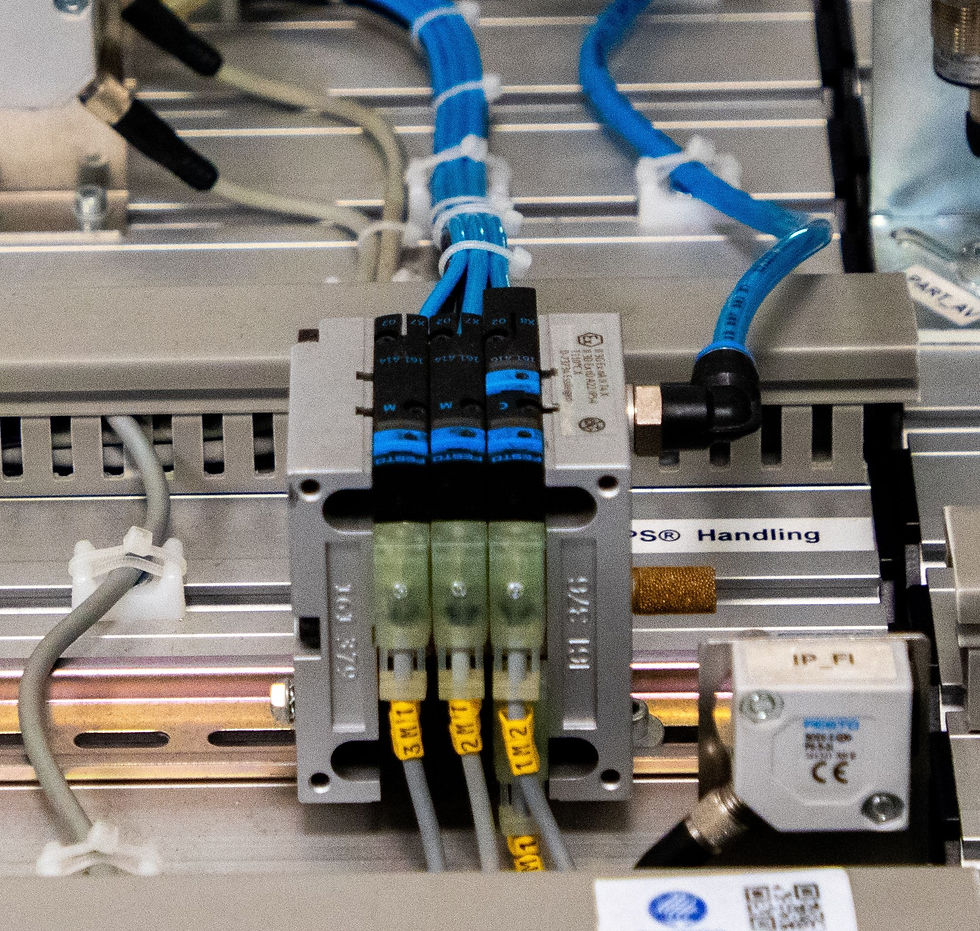
A bottle line has an 8-station valve manifold running the cylinders on the reject and diverter section: two reject pushers, a lane diverter, a bottle stop, and a few clamps.
An issue came up on second shift because the operator reported that the line was intermittently rejecting the bottle after a "low fill" and it's doing it on both rejectors.
The tech noticed a constant hiss from the manifold and couldn't localize the leak.
The tech did the following tests:
Soap-tests every fitting and hose on the machine. He finds two small leaks and fixes them. The hiss is still there.
Puts his hand on the manifold. The air is blowing out of the exhaust muffler on the right-hand end plate, right next to station 6.
Swaps the valve at station 6 with a new one from the crib. Still hisses.
Swaps station 5 for good measure. Still hisses.
Turns the regulator down 15 psi. Hiss gets quieter and it seems to be doing better, but still not right.
Two new valves, but it's still rejecting later than it should intermittently on both rejectors.
Where's the air actually coming from, and how would you find it?

Answer:
The valves were innocent. The culprit was the reject pusher cylinder at station 2, four stations away from where the air was coming out.
What was happening: piston seal blow-by.
A double-acting cylinder holds position by keeping air on one side of the piston and venting the other side to exhaust through the valve. The piston seal is the only thing keeping those two sides apart.
When that seal wears, pressurized air slips past the piston into the side that's supposed to be empty. That side is open to exhaust through the valve, by design. So the leaked air flows backward down the cylinder line, through the valve, and out the exhaust.
The valve is doing exactly what it's supposed to do. It's just passing along air the cylinder is leaking.
When this happens, you will also get variable speed and power from the cylinder because it isn't able to generate the desired pressure differential between sides.
On valve blocks, such continuous flow can overwhelm exhaust mufflers and cause every cylinder on the block to operate slower than intended and further slow down under higher actuation rates.
Why the hiss showed up at station 6.
Most manifolds don't give every valve its own exhaust. The exhaust ports feed a shared channel inside the manifold that dumps out through mufflers on the end plates. Air leaking through station 2 travels down that shared channel and comes out wherever the exhaust exits. In this case, that was the right-hand end plate, next to station 6.
So he followed the sound to the closest valve and replaced it. Then the next one. The sound told him where the air was leaving, not where it was coming from.
The clue he walked past.
The slow reject pusher. A cylinder that's bypassing air across the piston has pressure pushing back on both sides. Less net force, slower stroke, weaker kick. The symptom and the leak were the same problem. They just showed up in two different places.
Both reject cylinders acting up suggests that the outflow of air from the failing cylinder seals is starting to overwhelm the exhaust muffler.
How to prove it in five minutes:
With the cylinder holding position, pull the line on the unpressurized side of each cylinder. Use caution: make sure the cylinder can't move unexpectedly and the area is clear.
Feel or listen at the open port. A good cylinder will be open to atmosphere at the unperssurized side and no air will come out. A blown seal gives you a steady stream of air for as long as you leave it open.
If air is flowing through a cylinder, it needs to be replaced.
On a manifold with several cylinders, go cylinder by cylinder until you find which cylinder has bad seals.
Things that will wear a seal out faster than it should:
Dry, dirty, or wet air scoring the bore and chewing the seal
Side load on the rod from misalignment, a bent rod, or a pusher hitting product off-center
Running past the cylinder's rated cycle life on a high-speed reject
Lubrication changes: a cylinder that was run with oil and then switched to dry air can lose its factory grease film fast
Running higher pressure or impact than necessary. Cylinders should operate on the lowest pressure possible and stop as gently as possible at full stroke. This can require control of both pressure (regulator) and flow (needle valve) to achieve optimum results depending on configuration.
Fix the cause, or the new cylinder will die prematurely.
The lesson:
Follow the air to where it's leaving, then work backward to where it's coming from. They're not always the same place.
Expect cylinder seals to fail. Checking valve blocks for air exiting the exhaust while the machine is parked should be a PM you're doing regularly. It's a clear sign of cylinder leakage.
The location of a symptom isn't always the location of the problem. Finding the underlying cause is what keeps the same issue from returning.
If recurring equipment issues are costing your operation time and money, let's talk about how 180 OPEX can help.

Comments