

Anatomy of a Turnaround - Part 6: Maintenance

For some years, I believed that the fastest and easiest way to turn-around a plant is from the maintenance manager seat.
I no longer believe that to be true. However, there are some VERY important lessons I can share here that are useful to the turnaround leader.
Reactive Maintenance - What to expect if this is what you have
So, first, let's define how reactive maintenance works. In a reactive environment, typically there is not a clear line of execution from finding a problem to getting a plan/parts together and completing the work.
There are many reasons why this process may not be working well, but the result is always the same.
1) The only things that actually get fixed are things that down the equipment. That means that over time, every sensor, feature, and module that you can figure out a way to run without will be bypassed and worked-around. This will be justified lots of ways (not worth fixing, had to get it running, won't give time to fix it, nobody willing to buy the parts, etc, some of which will be partially true).
2) Over time, people won't know how to use any of the features the equipment is supposed to have because none of it works. Operator practices will become poor with loads of improper work-arounds. Typically, features which protect quality and high speed will fail and be left broken.
3) Poor operator practices will be indistinguishable from maintenance issues because they'll be intertwined. The maintenance issues will drive them and vice versa.
4) The actual "deferred maintenance cost" in the facility will rise indefinitely because (regardless of reason), you're effectively deferring everything you can (whether that's the intention or not).
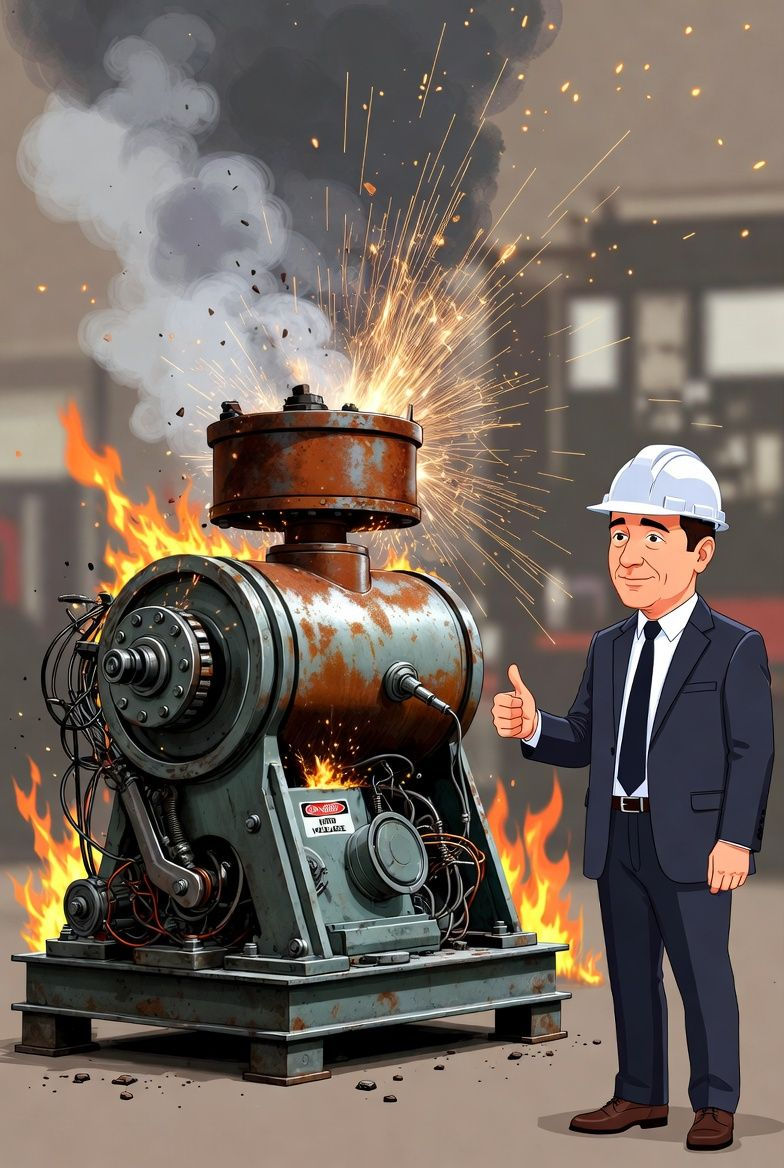
5) You will reach a point where the state of the equipment is rapidly degrading even the new parts you put on. Everything is mid-failure and the equipment will go down for breakage routinely.
6) Nobody will want to be responsible for anything. Production will try to outsource setups to maintenance. Maintenance will try to outsource responsibility to OEMs through contracts.
The ambiguous separation between what doesn't work and how the operators are supposed to work around it will make every problem unclear. None of those work-arounds will be documented. Operators and techs will see each other as opponents.
The "operational level of work" will tend to collapse and the whole team will converge on trying to do tactical level work to survive the day. Once the managers are working tactically the hierarchy itself will tend to collapse because the supervisors are being stepped-on by management constantly. The supervisors will stop leading and devolve into reporters.
This collectively constitutes a substantial level of organizational malfunction which will drive high levels of frustration, turnover, etc. Every metric will suffer.
So how do you beat it?
1) The first thing you need to realize when you walk into this environment is that the actual primary driver of your performance is NOT maintenance process. Controlling production process may actually be more important out-of-the-gate and is certainly more realistic.
The primary driver is the deferred maintenance (which may be millions of dollars). The process caused it, but you cannot perform until you deal with the deferred maintenance cost.
Yes, fixing maintenance process is critical to protecting the investment you will have to make to repair all this equipment.
However, it's hard to have a serious discussion with your technicians about preventative maintenance standards (and how they need to write up issues and get you a parts list) when you've got $4 million in deferred maintenance that you're intentionally not spending because you don't have the money.
You and they will know that you're not going to replace a stretched chain when you are struggling to come up with the money for stuff that is actually coming apart. I think it's important to be open about that.
Think "broken window syndrome." How can I demand they write up a cracked window if there is one next to it that's smashed out that I'm not willing to fix because I'm still trying to pay for the 5 alarm blaze in another part of the building?
When you walk into this scenario, there are two choices. The first one is the only one I have seen done.
1) Triage Maintenance - This is what I've had to do everywhere I've been. I don't believe this is the best way to do this. However, I have yet to meet the organization that was willing to do something else.
When you start down the road of triaging your way out of this scenario, realize that this is going to be a long and punishing road.
You need to assess your equipment, but diagnostic visits from your original equipment manufacturers are expensive. This requires balance. You want to balance how much you spend looking for problems with how long it'll take you to purchase the solutions.
It's not very helpful to diagnose beyond your spend projections. If you diagnose enough parts to where you can't order them all for 10 months, you risk the diagnostic being out-of-date or already fixed.
Most often, I would align with my team to make a priority list of lines. Then I would start diagnostic visits on the highest priority line. The reports from those diagnostic visits will be delivered with parts lists (and costs included) in addition to labor if you want to use the original equipment manufacturer (OEM) techs.
I recommend buying and installing all the parts. If your techs don't think they can do a job, bring in OEM labor and have your techs help so they can learn. You want the techs to own the state of the equipment. The reconstitution of all this equipment is a valuable training event and you really need to make sure you don't miss it.
This process will likely take 3-5 years if the plant has been reactive for long. It's not unusual for dilapidated equipment to have parts costs in the range of 20% of the original value of the equipment.
So if you have $10 million in equipment, I think it's reasonable (if your symptoms align with what I described earlier) to assume you may be looking at $2 million in deferred costs.
If you pull a couple diagnostic visits, that should give you a "sample" indication as to whether that is a good estimate.
What do I get if I return a machine to standard (buy and install all the parts from a good diagnostic visit)?
One of the first machines I "returned to standard" in my career consumed $145k in parts to return to standard. The second year when I did the diagnostic again after completing all that work, it needed $30k in parts. I think the third year it came in at $22k in parts.
One of the most recent machines I returned to standard needed $176k in parts. The second year assessment required $17k in parts.
One you break the deferred maintenance backlog, it's actually cheaper to maintain the equipment in top condition, and the machines will absolutely run better and more consistently.
Deferred Maintenance Cost should be a Metric
I have long thought that companies need to educate their executives on maintenance. "Deferred Maintenace Cost" should be a corporate level metric for every plant in a company.
Yes, scheduling 20 diagnostic visits at $15k each is expensive but not compared to what happens when you can't see all that deferred cost. It is absolutely an executive level responsibility to ensure the custodians of a plant are taking care of it.
This is a critical metric.
Every year, every primary machine should get a diagnostic visit scheduled by corporate and every job identified that isn't done should be carried as "deferred maintenance cost."
This would help them identify when their management teams are running a plant downhill. This would help with budgeting. The benefits are immense.
When equipment is in good shape you can defer costs for years. If a plant leader is trying to get promoted, he can defer costs on equipment to inflate profit. In the short term, that can really inflate performance. However, the bill will come due in the form of future poor performance.
So what do I do?
1) Triage method
First, get your work order system working and create functional planning and scheduling processes. In a reactive environment, those practices likely aren't used. You will need those just to manage the work you have to get done but they'll also be necessary to ensure you're doing the basics of preventative maintenance.
Whatever your limiting factor is, optimize it. I've been in a situation where tech labor was my limiting factor. Don't let an hour of unscheduled time slip by. If you're limited by budget dollars and you're having trouble keeping your techs busy, find ways to make that dollar go farther. There is always a more efficient way to squeeze a dollar.
Also, when I'm in triage, I admit it. I tell the techs we can't fix everything. They need to know and believe in the plan.
I explain how we are budgeting. I tell them to talk to me about the issues they find on PMs so we can order what we need to try to avoid breakdowns. But they need to know that you can't order all the stuff they find.
And I sit on a lot of spend because every day I need more money than I have.
I allocate as much money to parts as possible and try to do everything internally that I can. I beg my boss for money regularly.
And I pull a diagnostic visit or two, then try to buy all the parts and install them. Then get another diagnostic visit or two. Rinse, lather, repeat for 3 to 5 years.
One day, you will have spent every dollar you know of that the equipment needs. You will have money in the budget and, after covering everything you know of that needs done, you won't know how you need to spend it.
That is the day triage ends. From that point forward, you are in a state of normal maintenance process. Standard good maintenance practices are your world after that.
In theory, you will never again have to sit on spend. You should budget to pull diagnostics on all of your primary equipment annually. You should budget to be able to clear all diagnostics annually.
There are so many things that change over the course of this journey, but this is the meat of it.
2) Do it all now -
I want to see a company, from the executive level, run diagnostic visits on all of its primary equipment across all of its plants.
Once the company does that, I would like to see it correlate its performance and maintenance spends to the "deferred maintenance cost" reported by all those DVs across the plants. This would give valuable feedback and the ability to correlate the state of equipment to the performance of the equipment.
I think what you will find is that plants with lots of deferred maintenance don't run well and cost a lot to run at that poor state of maintenance. In fact, I think high levels of deferred maintenance will correlate to poor performance on EVERY METRIC.
I would love to see a company approach a turnaround from this perspective. Yes, you'll expense a lot and fast. However, you will also reduce future expenses substantially and enjoy a dramatic improvement in performance quickly.
You will also have a much higher chance of success. The act of going through the triage method is punishing and requires exceptional skill. The likelihood of hiring a player who can do it is limited.
Assessing the benefits -
Throughput accounting is a critical concept in approaching a turnaround. I want to explain this one with a case study.
A machine I returned to standard once was as follows:
1) Machine was rated at 14,000 units per hour.
2) Machine was in bad shape. It was capable of running a little over 10,000 units per hour because most of the high speed control systems didn't work. Intermittent downtime. Quality issues.
3) Cost to return this old machine to standard was $145k in parts.
4) Conventional wisdom was that we should not spend this money. Plant margins were very thin. Payback calculations showed it was a bad investment.
5) There was more work to be gained, but when calculated with current margins, the profit projections were poor. If "burden rates" for the equipment were used to calculate the benefits of repairing this equipment, the paybacks were terrible. Based on these calculations, we were not planning on returning this equipment to standard.
Enter Throughput Accounting, which is a much more accurate way to look at this.
1) If you think about it, margins are "Total Profit"/"Total Cost", which could be 0 even when you're profitably manufacturing something if you are only making enough units to break even. Projecting profit from improved production with "margin" is a very poor approach.
2) The correct way to assess future profit from an event that increases production rate (like fixing maintenance issues or decreasing inefficiencies) is to assess spread rate.
3) Spread is defined as "Sales price" minus "material cost". This allows you to assess the addition to the bottom line when there was no extra overhead/labor/etc from the change.
4) In this instance, the spread for a single unit was $0.60. By picking up ~4,000 units per hour, we could gain $2,400 an hour in additional spread.
Now, I think I ended up ballparking that we could gain 1 million units/month if we fixed this piece of equipment. I made promises, claimed we would increase profit by $0.60 x 1 million units, and convinced my leadership to spend that money.
And the Monday after all that work we came up and ran at 10k units/hour. No improvement.
And wow, was I worried about that. I made a lot of promises to get that money.
It was my boss who had the idea that maybe that stuff had all been broken so long that nobody knew how to use it. So he had me fly in a trainer.
Trainer brought that machine back up to 14k units/hour and retrained us. That machine cruised at 14,000 units/hour for the rest of my time with that company.
How did it work out?
We hit those profit projections. 8 months later we were plant of the year. Lots of people got promoted. Everyone was happy.
Why isn't this in alignment with what the maintenance industry is raving about?
First off, why does this article "gloss over" maintenance process fundamentals? Also, I didn't see anything about predictive maintenance, precision lubrication, AI assistants, or thermography. How can that be?
Preventative Maintenance:
The core components of an actual great preventative maintenance program (when the machines are at standard) are as follows: 1) Cleaning 2) Inspection and 3) Lubrication.
Cleaning: If you're in a reactive world, likely cleaning isn't getting a lot of attention. Probably production teams won't let a line be down for cleaning (they're probably fighting not to go down for actual maintenance either) and they don't have the control to get it done on down day. Also, because the machine is probably leaking 7 different fluids into a mystery soup around the base of the machine (because all the seals are rotted out), cleaning is likely not going to be a serious reality until some real repairs get done.
Inspection: The first assumption in the word "inspection" is that you would replace anything that needed to be inspected. However, if your team knows you aren't buying parts for anything short of a 5-alarm blaze (that multimillion dollar deferred maintenance backlog changes what they report) and the equipment is filthy (as it always is in reactive world), your inspections probably aren't great. They can't see much and don't expect you'll buy stuff even if they report it.
Lubrication: Techs actually tend to love lubrication in reactive environments. You see, they know pumping that bearing full of grease each week will make it last a little longer even though it's been on failure curve for 2 months. Most of the time I don't have to push the techs to lubricate more, but as we repair things, we need them to get less aggressive with it because they'll blow-out seals.
All this process work isn't really that far from success even when you're hip-deep in reactive. The most likely gap you have will be with maintenance planning and scheduling.
Considering all this, I stand by my assertion that the "diagnostic visit" is the ideal "inspection" to kick-off your repair and start returning your equipment to standard. It greatly simplifies the identification and planning of all those jobs.
The closer your equipment gets to standard, the closer your actual processes will mirror those "world class maintenance standards" you are reading about online.
As for predictive maintenance, and all those other swanky tools, those are all great tools which people are selling at a substantial premium. They aren't the cheapest way to do it.
I find the functionality of those is best only on machines and situations where I need lots of lead-time if there is a problem. Compressors, boilers, etc that are critical and for which you may not have high cost parts, load them up with tech so you won't miss anything.
I see those technologies as good, but fundamentally inferior to prevention: Cleaning, Inspection and Lubrication.
Every turnaround is different, but the underlying challenges are often the same: equipment reliability issues, deferred maintenance, and reactive work that consumes leadership attention.
180 OPEX helps manufacturers build operational systems that reinforce standards, reduce firefighting, and create lasting performance improvements.


Comments